

Article: Child's scalp: what you really need to know before shampooing
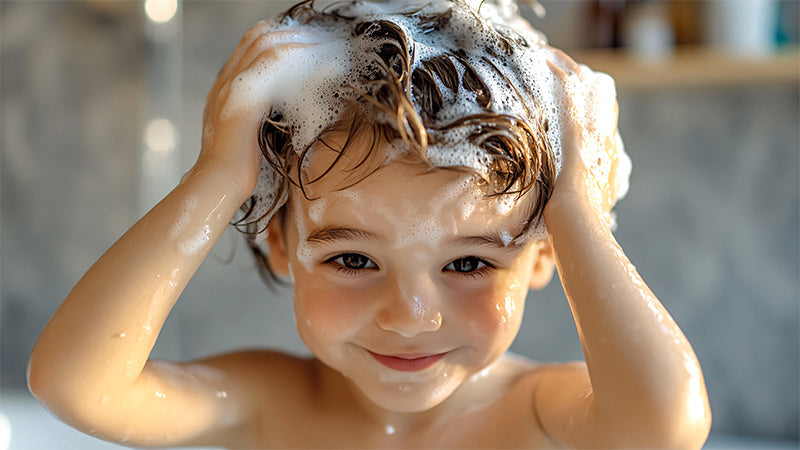
Child's scalp: what you really need to know before shampooing
Shampooing seems like the simplest thing in the world. And yet, for a child, it's not quite the same story as for an adult.
Here's what truly differentiates a child's scalp, and what that entails when it comes to washing.
A thinner, more reactive scalp
A child's scalp skin is thinner than an adult's, and its sebum production is different: lower in very young children, it then changes as they grow. The result: a child's scalp reacts more quickly to overly harsh products and dries out more easily than one might think.
Too much shampoo, or not enough: a matter of observation
We often hear conflicting advice. In reality, there isn't one universal good frequency: it mainly depends on the child's hair type and daily life (physical activity, sweating, outdoor play...).
Rather than a fixed rule, it's better to observe a few signals: itching, a noticeable smell, or hair that appears dull and heavy indicate that it's time to wash. Conversely, if the hair remains soft and shiny, there's no need to rush. In winter, when the air is drier and physical activity is reduced, shampoos can generally be spaced out without worry.
What matters most is not "how often," but "with what." An overly aggressive shampoo, even if used only once a week, can irritate a sensitive scalp. Conversely, a gentle and adapted formula can be used more regularly without drying it out.
Water that's too hot, a reflex to avoid
Just like for the skin, water that is too hot increases scalp dryness and can make it more prone to irritation. Lukewarm water, close to body temperature, remains the safest choice.
Rubbing, often too hard
In the rush of an evening routine, we sometimes tend to rub hard to "clean thoroughly." However, this is not necessary: a gentle fingertip massage is enough to clean effectively, without irritating the skin or further tangling the hair before detangling.
When drying, it's also best to avoid rubbing with a towel: gentle patting protects the scalp and prevents the creation of additional knots before the detangling step.
What to look for in the formula
The scalp naturally has a slightly acidic pH, generally between 5.4 and 5.9. This balance contributes to its natural protection against irritation. Here are some pointers for choosing a shampoo that respects it:
- Gentle cleansing agents (like glucosides), more respectful than classic sulfates
- A no-tear formula, precious during rinsing
- The absence of strong fragrance, often poorly tolerated by sensitive skin
- A product tested under dermatological control
Conversely, some ingredients should be avoided as much as possible: aggressive sulfates (like sodium laureth sulfate), silicones, parabens, and synthetic fragrances that are not clearly detailed on the label, which can hide substances poorly tolerated by sensitive skin.
"Mon Shampoing," from the Moments Doux range, is formulated to meet all these criteria.
A link in a broader routine
Shampooing is only the first step in a complete hair care ritual, often followed by detangling and then styling. A well-cleaned scalp, without aggression, also facilitates the subsequent steps: clean hair and a soothed scalp generally detangle more easily.
In summary
A child's scalp requires different attention than an adult's: a gentle formula rather than a strict frequency, lukewarm water, a light touch. A few simple adjustments are enough to transform this daily moment into a true act of care, without thinking twice.



Leave a comment
This site is protected by hCaptcha and the hCaptcha Privacy Policy and Terms of Service apply.