

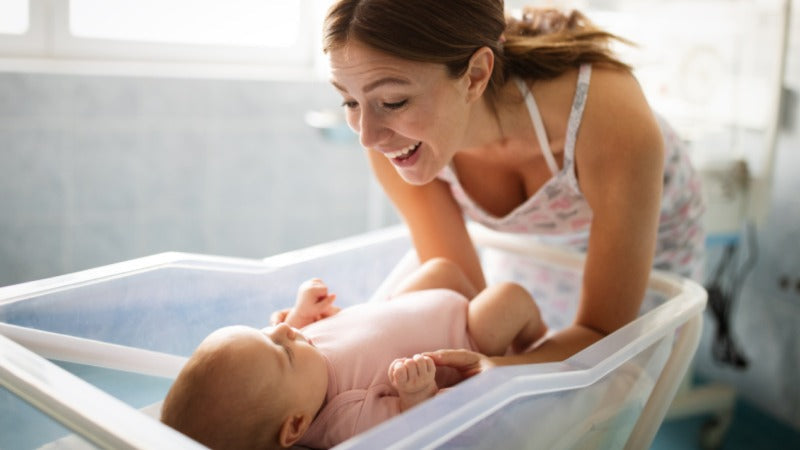
Baby's Bath: More Than Just a Hygiene Routine
Bath time is one of the very first daily rituals with a newborn. Often dreaded by new parents ("what if I do it wrong?"), it nevertheless deserves attention: not only for the baby's skin, of course, but also for everything this moment represents for them.
Skin still developing
At birth, a baby's skin is still developing. It has not yet developed its thin natural protective layer, the one that, in adults, limits dehydration and protects against external aggressions. As a result, a newborn's skin is thinner, more permeable, and absorbs more of what is applied to it.
This fragility does not disappear overnight: it gradually diminishes over the first few months, or even years.
Why the skin's "right balance" matters
Skin naturally has a slightly acidic pH, which helps it defend against bacteria and keep its protective film intact. In newborns, this balance is still being established during the first few weeks.
A classic soap, often too "stripping," can disrupt this fragile balance – hence the importance of cleansers specifically designed for this stage.
What to look for on the label
Some simple guidelines for choosing a product suitable for a newborn:
- A gentle, soap-free formula that doesn't dry out the skin
- No synthetic fragrance, often responsible for minor irritations in sensitive skin
- A product tested under dermatological control, ideally directly on infant skin
- A texture that lathers little, more comfortable for baby's eyes
Some 3-in-1 cleansing gels, like Moments Doux's Tendre Câlin, are formulated to meet all these criteria in a single product.
Water neither too hot nor too long
Water that is too hot dries out the skin more and can make the bath uncomfortable for baby. The ideal: water at around 37°C, close to body temperature, and a short bath.
The bath, a moment that goes far beyond hygiene
Beyond skin, bath time plays an important role in the very first interactions between a parent and their child. Skin-to-skin contact, a reassuring voice, repeated gestures: all of this contributes to building the attachment bond, an essential landmark for the infant's emotional security.
It is also one of the first moments when baby experiences new sensations: the water temperature, its texture on the skin, the sound it produces. These sensory stimulations contribute, in their own way, to their awakening.
Finally, the regularity of this ritual – always at roughly the same time, with the same gestures – helps the infant to orient themselves in time, long before they can understand the words to express it. This predictability contributes to a sense of security.
The wrapped bath: when baby returns to their pre-birth position
There is a practice, sometimes called "wrapped bath" or "therapeutic bath," which seeks to recreate the sensations the baby experienced before birth. Instead of a large volume of water, a small depth is used – a few centimeters are enough – in which the infant, free to move, spontaneously returns to their fetal position: arms and legs tucked against the body.
This position, combined with the feeling of weightlessness in warm water, seems to have a particularly soothing effect: some babies relax deeply, sometimes even falling asleep. The idea behind this practice is to offer a gentler transition between the containing environment of the maternal womb and the wider, less familiar outside world.
This approach requires some precautions (constant supervision, controlled water temperature) and can be learned from a midwife or trained professional before being reproduced at home.
In summary
A newborn's skin is still fragile and developing, which justifies special attention at bath time. But this ritual goes far beyond the issue of hygiene: it is also a time for bonding, sensations, and routine – and for some babies, a moment where they rediscover, for a few minutes, the sensations they knew before birth.



Leave a comment
This site is protected by hCaptcha and the hCaptcha Privacy Policy and Terms of Service apply.